Fluid Management Systems
Advancing fluid management in labs with automated small-volume filling
How can the introduction of automation in fluid management systems improve biopharma manufacturing?
Jonathan Haider at Single Use Support
There will always be a need for manual procedures in labs. In some cases, it simply does not make sense to change an effective system. However, there is room for improvement in several time-consuming and repetitive processes.
The landscape of lab design is undergoing a significant transformation. As the complexity and scale of biopharma manufacturing increases, so too does the need for advanced, reliable and efficient fluid management systems. Nowhere is this more evident than in the handling and filling of small volumes into single-use bags and bottles – a process that, until recently, was dominated by manual methods. Today, automation is emerging as a key enabler of safer, more consistent and scalable lab operations – even for small volumes. Or should it be said: even because the volumes are small?
The challenge of manual small-volume filling
Manual filling of small volumes, particularly in the context of advanced therapies and sensitive biologics, presents a host of challenges. Human error remains the leading cause of process deviations in pharma manufacturing, accounting for the majority of quality incidents and compliance risks. Manual processes are inherently prone to variability, with inconsistencies in fill volumes, increased risk of contamination, and significant resource demands for both labour and time.

Figure 1: Automated filling for small volume bottles
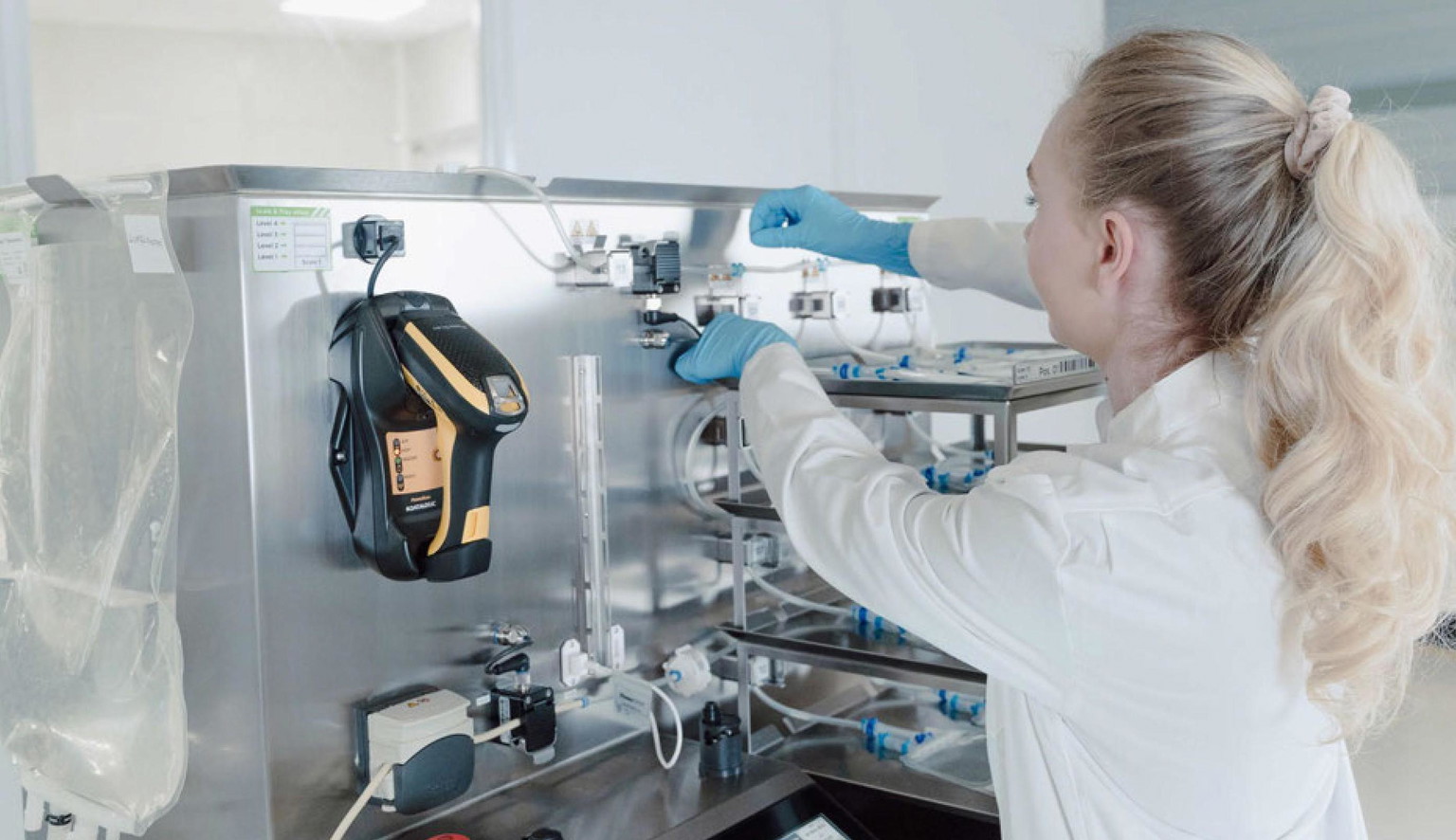
Small volume filling of ATMPs into single-use bags
For labs managing hundreds of aliquots per batch, for example in advanced therapy medicinal products (ATMP) fluid management, these inefficiencies are magnified. The lack of standardisation in manual aliquoting can compromise good manufacturing practice (GMP) compliance, while open handling increases the risk of microbial ingress and product loss.
Automation: a paradigm shift in fluid management
The move towards automated fluid management systems represents a paradigm shift for lab design. Automation enables the transition from open, manual processes to aseptically closed, highly controlled workflows. This shift is particularly impactful for small-volume filling, where precision and reproducibility are paramount (Figure 1).
Automated platforms can deliver filling accuracy down to sub-millilitre levels, supporting the stringent requirements of cell and gene therapy manufacturing and other advanced modalities. Integrated sensors and gravimetric controls ensure each aliquot meets exacting specifications, while parallel filling capabilities allow for significant scale-up without sacrificing quality or compliance.
Enhanced safety and contamination control
Automated systems minimise human intervention, which reduces the risk of contamination and ensures product integrity. Closed-system designs facilitate aseptic processing, which is critical for high-value biologics and advanced therapies.
“ Automation enables the transition from open, manual processes to aseptically closed, highly controlled workflows ”
Precision and consistency
Automation delivers exceptional accuracy and reproducibility, even with volumes as small as a few millilitres. This level of control is essential for meeting regulatory standards and ensuring consistent product quality across batches. A lack of precision in single-use bag aliquoting can ultimately threaten patient safety.
Resource optimisation
Automated fluid management systems streamline the aliquoting process, freeing up valuable personnel and reducing labour costs. Automated systems significantly reduce time, especially during scale-out operations, enabling labs to focus their resources on higher-value activities.
Scalability and flexibility
Modern automated platforms are designed to be modular providing labs with process flexibility and vendor-independence for a wide range of bag and bottle sizes and formats. This flexibility enables labs to adapt quickly to shifting production needs and batch sizes, future-proofing lab design against evolving industry demands.
Compliance and data integrity
Standardised processes and robust data capture through automation help meet relevant quality standards, such as GMP and 21 CFR Part 11. Electronic records and audit trails facilitate regulatory inspections and quality assurance.
Case study: From manual vial to automated bag filling
Recent case studies highlight the tangible benefits of transitioning from manual vial filling to automated small-volume bag filling. In one example, a mid-sized biotech company faced significant challenges with manual processes, including high contamination risk, inconsistent fill volumes and labour-intensive operations as they filled 3mL of viral vectors into vials manually under laminar flow. By adopting an automated, closed-system approach for single-use bags, the company achieved minimised contamination risk, enhanced filling accuracy, standardisation and reproducibility across batches, and significant time and resource savings during scale. Such process improvements not only support quality standards and product quality, but also enabled the company to meet the growing demands of advanced therapy manufacturing, such as viral vectors.
The future of lab design
As the biopharmaceutical industry continues to innovate, the role of advanced fluid management systems in lab design will only grow. Automation will be a necessity for labs seeking to ensure safety, efficiency and scalability in liquid transfer. Lab architects and managers can build future-ready facilities with automated small-volume filling platforms that support advanced therapies and scientific breakthroughs.
Jonathan Haider is the technical product owner for Fluid Management at Single Use Support. With his background in mechanical engineering and business, Jonathan brings his expertise to the field of fluid management solutions to advance liquid transfer in biopharma.

Innovations in Pharmaceutical Technology (IPT)
IPT provides a platform for cutting-edge ideas, concepts, and developments shaping the future of pharmaceutical R&D.